
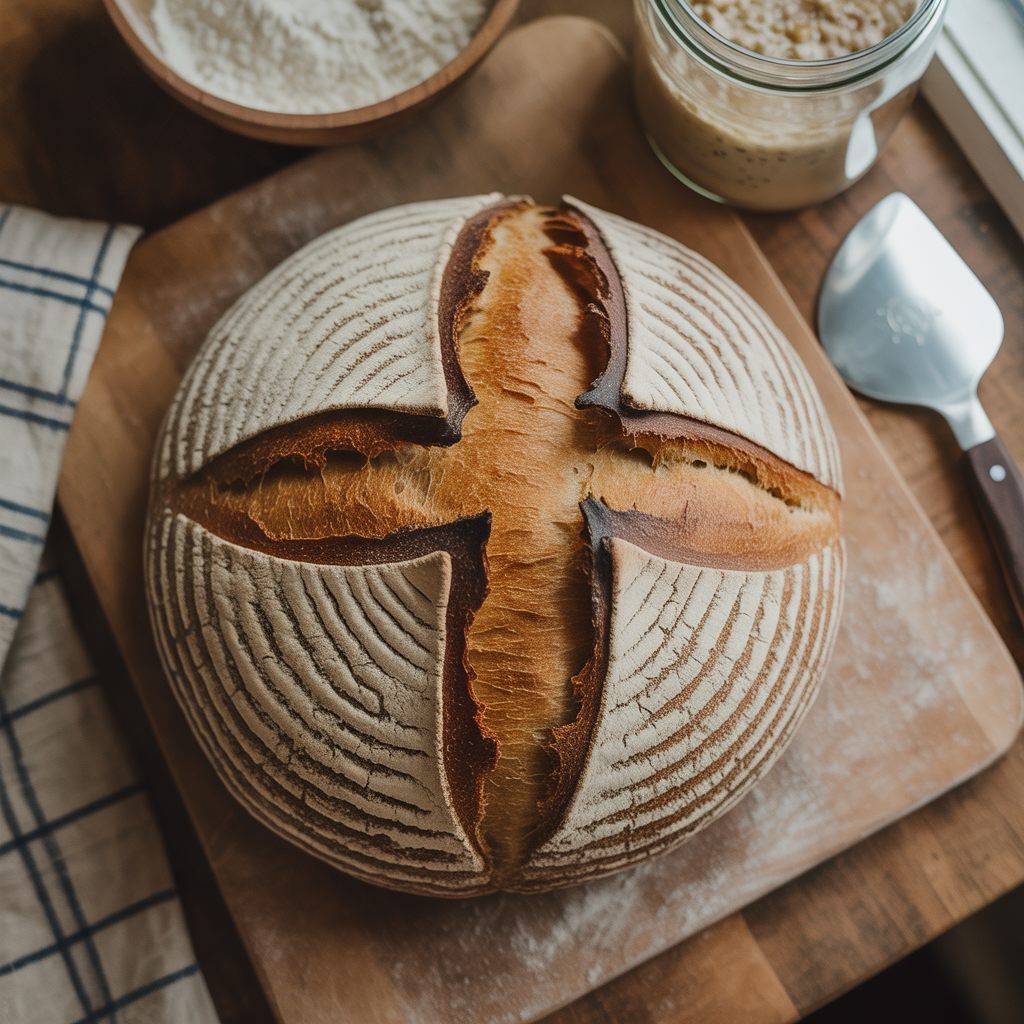
Making sourdough bread at home can seem intimidating at first, but with the right guidance, even a complete beginner can produce a beautiful, tangy loaf with a crispy crust and chewy interior. This comprehensive guide will walk you through every step of the process — from creating your starter to pulling that golden loaf out of the oven.
What Is Sourdough Bread?
Sourdough bread is one of the oldest forms of leavened bread in the world. Unlike conventional bread that uses commercial yeast, sourdough relies on a natural fermentation process powered by wild yeast and lactic acid bacteria. This gives sourdough its signature tangy flavor, chewy texture, and longer shelf life.
Beyond flavor, sourdough offers potential health benefits. The fermentation process breaks down gluten and phytic acid, making the bread easier to digest and improving nutrient absorption.
What You’ll Need Before You Start
Equipment
- Large mixing bowl
- Kitchen scale (highly recommended for accuracy)
- Banneton (proofing basket) or a bowl lined with a floured towel
- Dutch oven or heavy-lidded pot
- Bench scraper
- Bread lame or sharp razor blade for scoring
- Parchment paper
- Thermometer (optional but helpful)
Ingredients for Your Sourdough Starter
- Whole wheat or all-purpose flour
- Filtered or non-chlorinated water
Ingredients for the Bread Loaf
- 450g (about 3 ¾ cups) bread flour or all-purpose flour
- 325g (1 ⅓ cups) filtered water, room temperature
- 90g (about ⅓ cup) active sourdough starter
- 9g (1 ½ teaspoons) salt
Step 1: Create Your Sourdough Starter
Your sourdough starter is the heart of the bread. It’s a live culture of wild yeast and bacteria that you’ll maintain and use to leaven your bread. Building a healthy starter takes about 5 to 7 days.
Day 1
In a clean glass jar, mix together:
- 50g whole wheat flour
- 50g room-temperature water
Stir vigorously to incorporate air, cover loosely with a cloth or plastic wrap (not airtight), and let it sit at room temperature (ideally 70–75°F / 21–24°C) for 24 hours.
Day 2
You may or may not see bubbles yet — that’s okay. Discard half of your starter (about 50g), then feed it with:
- 50g all-purpose flour
- 50g water
Stir well and let rest for another 24 hours.
Days 3–7
Repeat the discard and feed process every 24 hours. By day 3 or 4, you should start seeing regular bubbles and a pleasant, slightly tangy smell. By days 5–7, your starter should be doubling in size within 4–8 hours of feeding — this means it’s active and ready to use.
Tip: To test if your starter is ready, drop a small spoonful into a glass of water. If it floats, it’s active enough to leaven bread. This is called the “float test.”
Step 2: Mix the Dough (Autolyse)
The night before or the morning you plan to bake, begin mixing your dough. Start with a technique called autolyse, which helps develop gluten naturally before kneading.
- In a large bowl, combine 450g flour and 300g water (reserve 25g of water for later).
- Mix until no dry flour remains. It will look rough and shaggy.
- Cover the bowl and let the dough rest for 30 to 60 minutes.
Step 3: Add the Starter and Salt
After the autolyse rest:
- Add 90g of your active sourdough starter to the dough.
- Dissolve 9g of salt in the remaining 25g of water and pour it over the dough.
- Use your hands to squeeze and fold the dough until the starter and salt are fully incorporated. This may take 3–5 minutes.
Cover the bowl and let it rest for 30 minutes.
Step 4: Stretch and Fold (Bulk Fermentation)
Instead of traditional kneading, sourdough uses a method called stretch and fold to build gluten structure. This phase is called bulk fermentation and lasts 4 to 6 hours at room temperature.
How to Stretch and Fold
- With wet hands, grab one side of the dough, stretch it up, and fold it over to the opposite side.
- Rotate the bowl 90 degrees and repeat.
- Do this 4 times to complete one set.
Perform 4 sets of stretch and folds, spaced 30 minutes apart (during the first 2 hours). After the 4th set, leave the dough to ferment undisturbed for the remaining 2–4 hours.
Signs Your Bulk Fermentation Is Complete
- The dough has grown by 50–75%
- It feels lighter and more airy
- Bubbles are visible on the surface and sides of the bowl
- The dough jiggles when you shake the bowl
Step 5: Shape the Dough
Once bulk fermentation is complete, it’s time to shape your loaf.
- Gently turn the dough out onto a lightly floured surface.
- Using a bench scraper, fold the edges toward the center to create surface tension.
- Flip the dough over so the seam side is down.
- Use your bench scraper to drag the dough toward you in a circular motion, creating a tight, round ball (boule) or oval (batard).
- Let the dough rest uncovered on the counter for 20–30 minutes (this is called bench rest).
Final Shape
- Lightly flour the top of the dough.
- Flip it over, fold the sides in, then roll it up tightly into your final shape.
- Place it seam-side up into a well-floured banneton or a bowl lined with a floured kitchen towel.
Step 6: Cold Proof Overnight
Cover your shaped dough loosely with plastic wrap or a shower cap and place it in the refrigerator for 8 to 16 hours. This cold proof (also called retarding) slows down fermentation, develops flavor, and makes the dough easier to score.
You can bake directly from the fridge without bringing the dough to room temperature first.
Step 7: Preheat Your Oven and Dutch Oven
At least 1 hour before baking, place your Dutch oven (with its lid) inside your oven and preheat to 500°F (260°C) or as high as your oven will go.
The extremely hot Dutch oven mimics a professional steam-injected bread oven, giving your bread an amazing oven spring and a crackling crust.
Step 8: Score and Bake
Scoring the Dough
- Cut a piece of parchment paper to fit inside your Dutch oven.
- Carefully flip your cold dough out of the banneton onto the parchment paper (seam side down now).
- Using a sharp bread lame or razor blade, score the top of the dough with a quick, confident slash at a 30–45 degree angle. This allows the bread to expand properly in the oven.
Baking
- First bake (with lid on): Carefully remove the hot Dutch oven from the oven. Using the parchment paper as a sling, lower the dough into the Dutch oven. Cover with the lid and bake at 500°F (260°C) for 20 minutes. The steam trapped inside creates a soft crust that allows maximum rise.
- Second bake (lid off): Remove the lid, reduce the oven temperature to 450°F (230°C), and continue baking for another 20–25 minutes until the crust is deep golden brown.
Tip: For a darker, thicker crust, turn off the oven, crack the door open slightly, and leave the bread inside for an additional 10 minutes.
Step 9: Cool the Bread
This step is crucial and often overlooked. Remove the bread from the Dutch oven and place it on a wire cooling rack. Do not cut into it for at least 1–2 hours.
The interior of sourdough bread continues to cook through residual heat even after it comes out of the oven. Cutting too early results in a gummy, undercooked crumb. Patience is key!
Sourdough Troubleshooting Guide
My bread is too dense
- Your starter may not be active enough — make sure it passes the float test before using.
- Bulk fermentation may have been too short — look for the visual signs described above.
- Your kitchen may be too cold — fermentation slows significantly below 68°F (20°C).
My bread didn’t rise in the oven (no oven spring)
- The dough may be over-fermented (over-proofed). If the dough feels very slack and sticky, it’s gone too far.
- Make sure your Dutch oven is fully preheated before adding the dough.
My crust is too pale
- Bake longer with the lid off.
- Make sure the oven is fully preheated.
My bread tastes too sour
- Reduce the cold proofing time.
- Use your starter earlier in its cycle (before it peaks).
- Use more white flour and less whole grain flour.
My bread is not sour enough
- Extend the cold proof time in the refrigerator.
- Use your starter at peak activity or slightly past peak.
- Add more whole wheat or rye flour to the dough.
How to Store Sourdough Bread
- Room temperature: Store cut-side down on a cutting board or in a paper bag for up to 3–4 days. Avoid plastic bags, which make the crust soggy.
- Freezer: Slice the bread first, then freeze in a zip-lock bag for up to 3 months. Toast slices directly from frozen.
Tips for Success as a Beginner
- Use a kitchen scale. Baking by weight is far more accurate than using cups and will give you consistent results every time.
- Keep notes. Track fermentation times, temperatures, and results so you can improve with each bake.
- Be patient. Sourdough is a slow process. Don’t rush fermentation.
- Temperature matters. A warmer kitchen speeds up fermentation; a cooler one slows it down. Learn to read your dough, not just the clock.
- Practice, practice, practice. Your second loaf will be better than your first, and your tenth will be better than your fifth.
Sourdough Bread Recipe Summary
| Step | Action | Time |
|---|---|---|
| 1 | Build starter | 5–7 days |
| 2 | Autolyse | 30–60 min |
| 3 | Add starter & salt | 30 min rest |
| 4 | Bulk fermentation + stretch & fold | 4–6 hours |
| 5 | Shape dough | 30 min |
| 6 | Cold proof in fridge | 8–16 hours |
| 7 | Preheat oven & Dutch oven | 1 hour |
| 8 | Score & bake | 40–45 min |
| 9 | Cool on wire rack | 1–2 hours |
Frequently Asked Questions
Can I use all-purpose flour instead of bread flour?
Yes! All-purpose flour works well for beginners. Bread flour has a higher protein content, which results in a chewier crumb and better rise, but all-purpose flour will still give you a delicious loaf.
How long does it take to make sourdough bread from start to finish?
Including the time to build your starter, the process takes about 7–10 days for your very first loaf. After that, each subsequent bake takes roughly 24–36 hours from mixing to cooling.
Do I have to use a Dutch oven?
A Dutch oven is highly recommended because it traps steam and creates an ideal baking environment. However, you can also bake on a preheated baking stone or sheet pan and create steam by placing a pan of boiling water at the bottom of the oven.
How do I know if my sourdough starter is dead?
If your starter shows zero activity (no bubbles at all) after regular feedings for several days, smells strongly of acetone or alcohol, or develops visible mold (pink or orange streaks), it may be time to start a new one.
Can I speed up the fermentation process?
You can place your dough in a slightly warmer environment (like an oven with just the light on) to speed up bulk fermentation. However, avoid rushing the cold proof — it’s essential for flavor development.
Final Thoughts
Making sourdough bread is one of the most rewarding kitchen skills you can learn. It connects you to thousands of years of baking tradition while giving you full control over the ingredients in your bread. Yes, it takes time and practice — but the moment you pull that first golden, crackling loaf out of the oven and hear it sing as it cools, you’ll understand why so many home bakers fall in love with the process.
Start your starter today, follow this guide, and don’t get discouraged by imperfect early loaves. Every bake teaches you something new. Happy baking!