
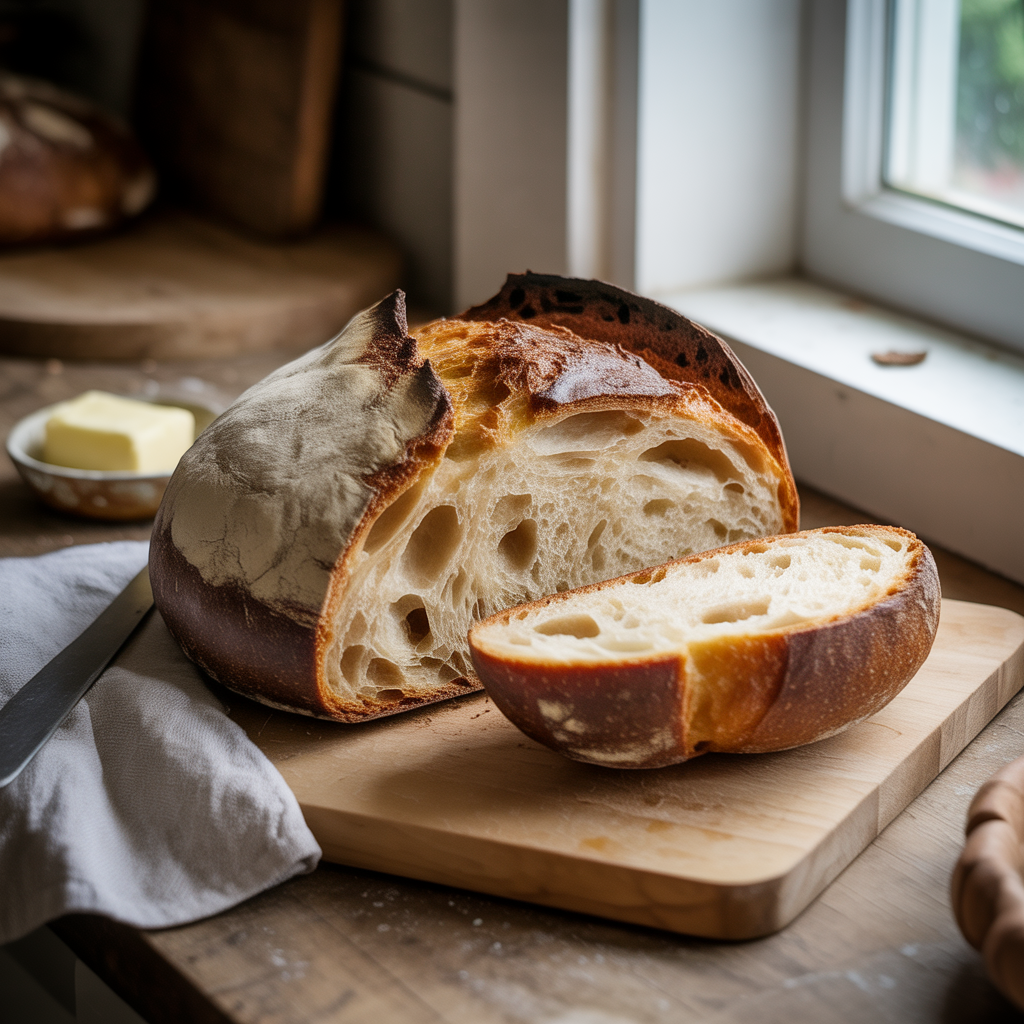
If you’ve ever dreamed of pulling a beautifully golden, crackling loaf of sourdough bread out of your own oven, you’re in the right place. This beginner sourdough bread recipe will walk you through every step — from building your starter to scoring your first loaf — with clear instructions that make the process approachable, rewarding, and genuinely delicious.
Sourdough is one of the oldest forms of leavened bread in the world. Unlike commercial yeast breads, sourdough relies on a wild yeast starter — a live culture of flour and water — to rise the dough and develop that signature tangy flavor. The result is a crusty, chewy loaf with complex taste that simply can’t be replicated with a packet of instant yeast.
Don’t be intimidated. Once you understand the rhythm of sourdough baking, it becomes second nature. Let’s dive in.
What Is Sourdough Bread?
Sourdough bread is a naturally leavened bread made using a fermented starter instead of commercial yeast. The starter contains wild yeast and lactic acid bacteria (LAB), which work together to:
- Leaven (rise) the dough
- Develop flavor through fermentation
- Improve digestibility by breaking down gluten and phytic acid
- Extend the shelf life of the bread naturally
The characteristic sourness comes from the organic acids — primarily lactic and acetic acid — produced during fermentation. A longer, cooler fermentation produces a more pronounced tang, while a shorter, warmer fermentation yields a milder flavor.
Why Make Sourdough at Home?
There are plenty of compelling reasons to bake sourdough yourself rather than buying it from a store:
- Flavor: Homemade sourdough has a depth of flavor that store-bought bread rarely achieves.
- Ingredients: You control exactly what goes into your bread — just flour, water, salt, and starter.
- Health benefits: Fermentation makes sourdough easier to digest and may lower its glycemic index compared to standard bread.
- Cost-effective: Once you have an active starter, a large loaf costs just pennies to make.
- Satisfaction: There is something deeply satisfying about baking your own bread from scratch.
Understanding Your Sourdough Starter
Before you can bake sourdough bread, you need an active, bubbly sourdough starter. This is the heart of every sourdough loaf.
What Is a Sourdough Starter?
A sourdough starter is a mixture of flour and water that has been colonized by wild yeast and beneficial bacteria from the environment. When fed regularly, it becomes a living leavening agent that can be used indefinitely.
How to Make a Sourdough Starter from Scratch
What you need:
- Whole wheat flour or unbleached all-purpose flour
- Filtered or room-temperature tap water (chlorine-free is best)
- A clean glass jar
- A kitchen scale
Day-by-Day Guide:
Day 1: Mix 50g whole wheat flour + 50g water in a jar. Stir well, cover loosely, and leave at room temperature (around 70–75°F / 21–24°C) for 24 hours.
Day 2: You may see small bubbles beginning to form. Discard half the starter (about 50g), then add 50g fresh flour + 50g water. Stir and cover.
Day 3–5: Repeat the feeding process every 24 hours. The starter should begin to show more activity — rising, bubbling, and developing a slightly sour smell.
Day 6–7: Feed twice a day if possible. Your starter is ready when it consistently doubles in size within 4–8 hours of feeding and smells pleasantly tangy and yeasty.
The Float Test
To check if your starter is ready to bake with, drop a small spoonful into a glass of water. If it floats, it’s active and full of gas — ready to use. If it sinks, give it another feeding and try again in a few hours.
Beginner Sourdough Bread Recipe
This recipe makes one medium sourdough loaf (approximately 900g baked weight). It uses simple ingredients and a relaxed timeline that fits into most people’s schedules.
Equipment You’ll Need
- Kitchen scale (essential for accuracy)
- Large mixing bowl
- Bench scraper
- Banneton (proofing basket) or a bowl lined with a floured cloth
- Dutch oven or heavy cast-iron pot with lid
- Sharp knife, lame, or razor blade for scoring
- Oven mitts
- Parchment paper
Ingredients
- 450g bread flour (or all-purpose flour — higher protein is better)
- 325g lukewarm water (about 75–80°F / 24–27°C)
- 90g active sourdough starter (fed and bubbly)
- 9g fine sea salt
Hydration note: This is approximately a 72% hydration dough — manageable for beginners while still producing an open, airy crumb.
Step 1: Autolyse (8:00 AM)
In a large bowl, combine 450g flour and 290g of the water (reserve 35g for later). Mix until no dry flour remains. Cover the bowl and let it rest for 30–60 minutes.
This rest period, called the autolyse, allows the flour to fully hydrate and begins gluten development without any kneading. It makes the dough more extensible and easier to work with.
Step 2: Add Starter (8:45 AM)
Add the 90g of active starter to the autolysed dough. Use your fingers to squeeze and fold the starter into the dough until fully incorporated. This takes about 3–5 minutes of squeezing and folding.
Cover the bowl and let rest for 30 minutes.
Step 3: Add Salt (9:15 AM)
Dissolve the 9g salt in the remaining 35g of water. Pour it over the dough and again use your fingers to squeeze and incorporate it fully.
This is your dough fully assembled. Now the bulk fermentation begins.
Step 4: Bulk Fermentation with Stretch and Folds (9:15 AM – 2:15 PM)
Bulk fermentation is where the magic happens. The wild yeast and bacteria ferment the dough, developing flavor and structure. This typically takes 4–6 hours at room temperature (around 75°F / 24°C). Warmer rooms ferment faster; cooler rooms take longer.
During the first 2 hours, perform stretch and folds every 30 minutes (4 sets total):
To perform a stretch and fold:
- Wet your hand to prevent sticking.
- Grab one side of the dough, stretch it upward as far as it will go without tearing, then fold it over to the opposite side.
- Rotate the bowl 90° and repeat — do this 4 times per set (north, south, east, west).
- Cover and rest 30 minutes before the next set.
After the 4th set, leave the dough undisturbed for the remainder of bulk fermentation. You’ll know bulk fermentation is complete when the dough has increased in volume by 50–75%, feels airy and jiggly, and you can see bubbles on the surface and sides of the bowl.
Step 5: Pre-Shape (2:15 PM)
Gently turn the dough out onto a clean, unfloured work surface. Using a bench scraper and your free hand, fold the edges of the dough toward the center, then flip it over so the seam is face-down.
Using the bench scraper, drag the dough ball toward you in a circular motion to build surface tension. This creates a tight, smooth skin on the outside of the dough.
Let the pre-shaped dough rest uncovered on the bench for 20–30 minutes (this is called the bench rest).
Step 6: Final Shape (2:45 PM)
Lightly flour your work surface. Flip the dough ball over using your bench scraper so the smooth side faces down.
For a round loaf (boule):
- Fold the bottom third of the dough up toward the center.
- Fold the left side in, then the right side.
- Fold the top down and press gently to seal.
- Flip the dough over and use your hands and bench scraper to drag it toward you, building surface tension.
For a batard (oval loaf):
- Gently pat the dough into a rectangle.
- Fold the top down to the center, then fold in the sides.
- Roll the dough toward you tightly, then seal the seam.
Transfer the shaped dough seam side up into a well-floured banneton or a bowl lined with a well-floured kitchen towel. Dust the top generously with flour.
Step 7: Cold Proof (Overnight in the Fridge)
Cover the banneton tightly with plastic wrap or a shower cap and place it in the refrigerator for 8–16 hours (or overnight).
Cold proofing slows fermentation, allowing even more flavor development. It also makes the dough firmer and easier to score. You can bake it the next morning whenever you’re ready — the cold proof is very forgiving.
Alternative: If you prefer to bake the same day, you can proof at room temperature for 2–4 hours until the dough passes the poke test (see below).
The Poke Test
Gently poke the dough with a floured finger about 1/2 inch deep. If the indentation springs back slowly and partially, the dough is ready to bake. If it springs back immediately, it needs more time. If it doesn’t spring back at all, it may be over-proofed.
Step 8: Baking (Next Morning)
Preheat your oven to 500°F (260°C) with the Dutch oven inside for at least 45–60 minutes. The Dutch oven must be screaming hot before you load the bread.
When ready to bake:
- Tear a piece of parchment paper slightly larger than your loaf.
- Remove the banneton from the fridge. Flip the dough out onto the parchment paper (seam side down now).
- Working quickly, use a lame, razor blade, or very sharp knife to score the top of the loaf at a 30–45° angle, making one confident slash about 1/2 inch deep. This allows the bread to expand properly in the oven.
- Carefully remove the hot Dutch oven from the oven. Lift the dough using the parchment paper and lower it into the Dutch oven.
- Bake covered at 500°F (260°C) for 20 minutes. The steam trapped inside creates the crackling crust.
- Remove the lid, reduce the temperature to 450°F (230°C), and bake for another 20–25 minutes until the crust is a deep golden-brown (almost dark mahogany).
- Remove the bread from the Dutch oven and place on a wire rack.
The Most Important Step: Cooling
We know it’s tempting, but do not cut into the bread for at least 1–2 hours after baking. The interior is still cooking and the crumb structure is still setting. Cutting too early will result in a gummy, doughy interior. The wait is absolutely worth it.
Sourdough Baking Schedule Overview
Here’s a simple timeline to help you plan your bake:
- Night before baking (8:00 PM): Feed your starter
- Morning of (8:00 AM): Autolyse (mix flour + water)
- 8:45 AM: Add starter
- 9:15 AM: Add salt, begin bulk fermentation
- 9:15 AM – 11:15 AM: Stretch and folds every 30 min (4 sets)
- 11:15 AM – 2:15 PM: Continue bulk fermentation undisturbed
- 2:15 PM: Pre-shape + bench rest
- 2:45 PM: Final shape + into the fridge
- Next morning: Preheat oven, score dough, bake
Tips for Beginner Sourdough Success
Use a Kitchen Scale
Baking by weight is far more accurate than measuring by volume. Investing in a simple digital kitchen scale will dramatically improve your results.
Temperature Matters
Wild yeast is temperature-sensitive. Fermentation happens faster in a warm environment and slower in a cool one. The ideal dough temperature is around 75–78°F (24–26°C). If your kitchen is cold, try placing the dough near your oven with just the light on, or inside a slightly warm oven.
Use a Strong, Active Starter
Only use your starter when it’s at or near peak activity — when it has roughly doubled in size and is full of bubbles. Using a sluggish starter is the number one reason beginner loaves fail to rise.
Don’t Rush the Process
Sourdough is a slow bread. Rushing bulk fermentation or proofing will result in dense, flat loaves. Trust the timing and the dough’s visual cues rather than the clock.
Score Confidently
When scoring, use a swift, decisive motion. A hesitant score drags the dough. Keep your blade at a 30–45° angle and move in one smooth stroke.
Get Your Dutch Oven Very Hot
A cold Dutch oven will not give you the oven spring and crust you’re looking for. Give it a full 45–60 minutes to preheat with the oven.
Embrace Imperfection
Your first loaf may not look like the ones you see on Instagram — and that’s completely okay. Every bake teaches you something new. The more you bake, the more intuitive it becomes.
Troubleshooting Common Sourdough Problems
My bread didn’t rise (flat loaf)
Possible causes: Starter was not active enough, bulk fermentation was too short, or the kitchen was too cold. Make sure your starter passes the float test and doubles reliably before using it in a recipe.
My crumb is too dense
Possible causes: Under-fermentation, not enough gluten development during stretch and folds, or dough was too stiff. Try extending bulk fermentation or adding an extra stretch and fold session.
My bread is too sour
Possible causes: Over-fermentation or a very long cold proof. Try reducing the cold proof time to 8 hours instead of 16, or ferment at a slightly warmer temperature to favor lactic acid (milder, dairy-like flavor) over acetic acid (sharper, more vinegary flavor).
My crust isn’t crispy
Possible causes: Dutch oven wasn’t hot enough, or the bread was removed too soon. Make sure the crust is deeply browned before removing it from the oven. Let it cool fully — the crust crisps up as moisture evaporates during cooling.
My dough is too sticky to shape
Possible causes: Too much water for the flour you’re using, or insufficient gluten development. Use wet hands instead of flour when working with sticky dough, and try reducing hydration to 68% (305g water) on your next bake.
My score didn’t open up (“ear” didn’t develop)
Possible causes: Score wasn’t deep enough or angled properly. Score at least 1/2 inch deep at a 30–45° angle. Also, a cold dough scores more cleanly — bake straight from the fridge.
Sourdough Flour Variations
Once you’re comfortable with the basic recipe, try experimenting with different flours to change the flavor and texture of your loaf:
- Whole wheat flour: Substitute up to 20% of bread flour with whole wheat for a nuttier, earthier flavor and a slightly denser crumb.
- Rye flour: Even a small amount (5–10%) adds complex, robust flavor and accelerates fermentation due to its high enzyme activity.
- Spelt flour: Adds a mild, slightly sweet nuttiness. Use no more than 20–30% as it has weaker gluten than bread flour.
- Einkorn flour: An ancient grain with a rich, buttery flavor. Best used in small ratios due to its fragile gluten structure.
Add-Ins and Variations
Once you master the basic loaf, these additions can take your sourdough to the next level:
- Seeds: Sesame, sunflower, flax, or caraway seeds mixed into the dough or pressed into the surface.
- Olives and rosemary: Fold in chopped kalamata olives and fresh rosemary during the final stretch and fold.
- Cheese and jalapeño: A crowd-pleasing combination — fold in shredded cheddar and diced jalapeño.
- Dried fruit and nuts: Cranberry walnut sourdough is a classic — add during shaping for a beautiful, flavorful loaf.
- Honey or maple syrup: A tablespoon added with the starter will give a subtle sweetness and a slightly softer crumb.
How to Store Sourdough Bread
Sourdough keeps better than most breads thanks to its natural acidity, which inhibits mold growth.
- Room temperature: Store cut-side down on a wooden cutting board, or wrap loosely in a clean kitchen towel. Keep for 3–5 days.
- Avoid plastic bags: Plastic traps moisture and makes the crust soggy.
- Freezing: Slice the loaf and freeze in a zip-lock bag. Toast slices directly from frozen — they taste nearly fresh. Frozen sourdough keeps for up to 3 months.
How to Maintain Your Sourdough Starter Long-Term
Your sourdough starter can last indefinitely with proper care. Here’s how to maintain it:
- Regular bakers (weekly): Keep your starter at room temperature and feed it once or twice a day — equal parts starter, flour, and water by weight.
- Occasional bakers: Store your starter in the fridge and feed it once a week. Take it out 1–2 days before baking to wake it up.
- Long-term storage: Spread starter thinly on parchment paper, let it dry completely, then crumble into flakes and store in an airtight jar. This “dehydrated starter” can be revived with water whenever needed.
Frequently Asked Questions
Can I use all-purpose flour instead of bread flour?
Yes, you can. Bread flour has a higher protein content (12–14%) which builds stronger gluten and gives a better rise and chewier crumb. All-purpose flour (10–12% protein) will still produce a lovely loaf, but may be slightly less airy. If using all-purpose, consider reducing the water by about 10–15g to avoid an overly sticky dough.
How long does it take to make sourdough from start to finish?
Including starter preparation, expect the full process to take about 24–48 hours, though most of that time is hands-off fermentation. Active working time is only about 30–45 minutes total.
Do I have to use a Dutch oven?
A Dutch oven creates the steam environment critical for good oven spring and a crackly crust. If you don’t have one, you can bake on a preheated baking stone or steel and create steam by placing a pan of boiling water on the oven floor for the first 20 minutes. Results won’t be identical, but can still be very good.
Can I make sourdough without a banneton?
Absolutely. Line a regular bowl or colander with a clean kitchen towel, dust it generously with flour (rice flour is excellent for this), and use that as your proofing vessel.
Why does my sourdough smell like alcohol?
A strong alcohol or acetone smell from your starter means it’s been over-fermented or under-fed (it’s hungry!). Discard most of it and feed with fresh flour and water. The smell should improve within one or two feedings.
Is sourdough bread gluten-free?
Traditional sourdough is NOT gluten-free, as it is made from wheat flour. However, the long fermentation does break down some of the gluten, making it easier to digest for some people with mild gluten sensitivity (not celiac disease). For a truly gluten-free sourdough, you would need to use gluten-free flours and a specially cultivated gluten-free starter.
What to Serve with Sourdough Bread
Your freshly baked sourdough is incredibly versatile. Here are some favorite ways to enjoy it:
- Slathered with high-quality salted butter and a drizzle of honey
- Topped with avocado, flaky salt, and red pepper flakes
- As the base for a classic tomato bruschetta
- Alongside a hearty soup or stew for dipping
- Grilled and rubbed with garlic for garlic bread
- Made into a killer grilled cheese sandwich
- Used as the bread for French toast the next day
Final Thoughts
Baking your first sourdough loaf is one of the most rewarding kitchen experiences you can have. Yes, it takes time and patience — but the process is largely hands-off, and the payoff is extraordinary. A loaf with a crackling crust, a chewy, open crumb, and that unmistakable tangy depth of flavor that only true sourdough can deliver.
Start with this recipe exactly as written. Once you’ve baked it a few times and begin to understand how the dough looks and feels at each stage, you can start experimenting with hydration levels, flour blends, fermentation times, and flavor additions.
Remember: every bake makes you a better baker. Trust the process, embrace the journey, and enjoy every slice.
Happy baking!