
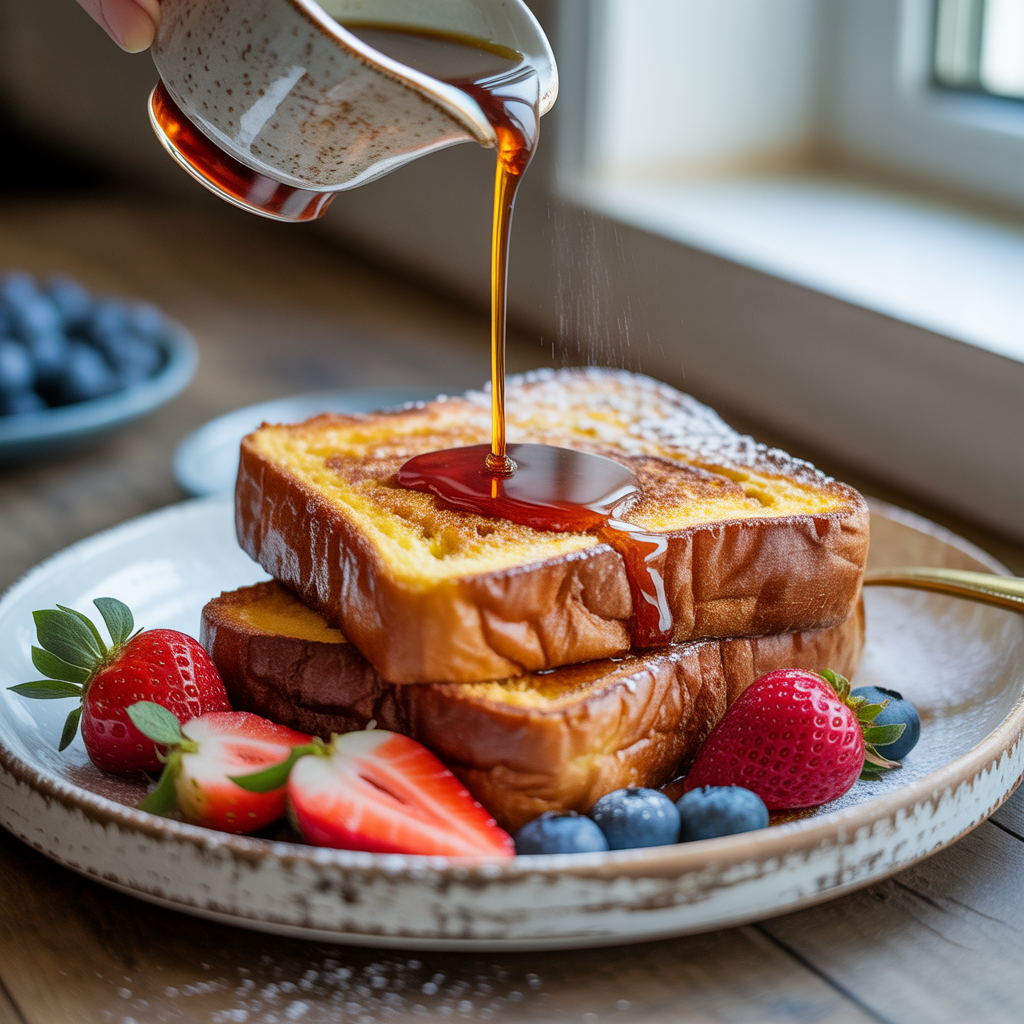
If you’ve ever wondered how to make French toast that’s perfectly crispy on the outside yet rich and custardy on the inside, you’ve come to the right place. This guide covers everything you need to know — from choosing the right bread to nailing the custard ratio and cooking technique — so you can make the best French toast every single time.
What Makes the Best French Toast?
Great French toast comes down to three things: the right bread, a well-balanced custard mixture, and the proper cooking technique. Skip any one of these and you’ll end up with soggy, eggy slices or dry, rubbery toast. Follow all three and you’ll have a breakfast that feels like it came straight from a brunch restaurant.
Best Bread for French Toast
Not all bread is created equal when it comes to French toast. The ideal bread should be thick, sturdy, and slightly dry so it absorbs the custard without falling apart.
- Brioche – The gold standard. Rich, buttery, and pillowy with a tight crumb that soaks up custard beautifully.
- Challah – Slightly less rich than brioche but equally excellent. Slightly sweet and egg-enriched.
- Texas Toast – Thick-cut white sandwich bread. A budget-friendly option that still delivers great results.
- Sourdough – Adds a subtle tang. Works great for a more grown-up, less sweet version.
- French Baguette (sliced) – Crusty exterior and chewy interior. Ideal for an authentic French-style toast.
Pro Tip: Use bread that is 1 to 1.5 inches thick and ideally one day old (stale). Day-old bread has less moisture, which means it can absorb more custard without becoming mushy.
The Perfect Custard Mixture
The custard is the heart of French toast. Getting the ratio of eggs, dairy, and flavorings right is what separates average French toast from extraordinary French toast.
Ingredients for the Custard
- 3 large eggs
- ¾ cup whole milk or heavy cream (or a mix of both)
- 1 tablespoon granulated sugar
- 1 teaspoon pure vanilla extract
- ½ teaspoon ground cinnamon
- ¼ teaspoon ground nutmeg (optional but recommended)
- Pinch of salt
Custard Tips
- Use whole milk or heavy cream – Low-fat milk produces a thinner custard that won’t give you that luscious, creamy interior.
- Whisk thoroughly – Make sure the eggs are fully incorporated. Streaks of egg white will cook unevenly on the bread.
- Don’t skip the salt – A small pinch of salt balances the sweetness and enhances all the other flavors.
- Add vanilla and cinnamon – These are non-negotiable flavor boosters that take your French toast to another level.
Best French Toast Recipe
Ingredients (Serves 4)
- 4–6 thick slices of brioche or challah bread (about 1 to 1.5 inches thick)
- 3 large eggs
- ¾ cup whole milk
- ¼ cup heavy cream
- 1 tablespoon sugar
- 1 teaspoon vanilla extract
- ½ teaspoon ground cinnamon
- ¼ teaspoon ground nutmeg
- Pinch of salt
- 2 tablespoons unsalted butter (for the pan)
Equipment Needed
- Large shallow baking dish or wide bowl
- Large non-stick skillet or cast iron pan
- Wire rack (optional, for resting)
- Whisk
Step-by-Step Instructions
Step 1: Prepare Your Bread
If your bread is fresh, place the slices on a wire rack and let them sit out uncovered for 30–60 minutes, or place them in a 275°F (135°C) oven for 10 minutes. Drying out the bread slightly helps it absorb the custard more effectively without becoming soggy.
Step 2: Make the Custard
In a large shallow dish (a pie plate or 9×13 baking dish works perfectly), whisk together the eggs, whole milk, heavy cream, sugar, vanilla extract, cinnamon, nutmeg, and salt. Whisk vigorously until the mixture is smooth and no streaks of egg remain.
Step 3: Soak the Bread
Place one or two slices of bread into the custard mixture. Let them soak for 30–45 seconds per side for thin slices, or up to 60 seconds per side for thick slices like brioche. The bread should feel saturated but not falling apart. You should see the custard absorbed into the interior — gently press the bread to help it absorb.
Important: Do not over-soak the bread, especially soft brioche. Over-soaking leads to a wet, mushy interior that won’t cook properly.
Step 4: Heat the Pan
Heat a large non-stick skillet or cast iron pan over medium to medium-low heat. This is crucial — too high a heat will burn the outside before the inside is cooked. Add 1 tablespoon of butter and let it melt and foam. Swirl it to coat the pan evenly.
Pro Tip: For the crispiest edges, use a combination of butter and a neutral oil like canola oil. Butter adds flavor while the oil raises the smoke point and prevents burning.
Step 5: Cook the French Toast
Carefully lay the soaked bread slices into the hot pan. Cook undisturbed for 3–4 minutes until the bottom is deeply golden brown and crispy. Flip and cook the other side for another 2–3 minutes.
For very thick slices, you can finish them in a 350°F (175°C) oven for 5 minutes after pan cooking to ensure the center is fully set without over-browning the crust.
Step 6: Rest and Serve
Transfer the cooked French toast to a wire rack for 1–2 minutes before serving. This keeps the exterior crispy rather than steaming itself soggy on a flat plate.
Toppings and Serving Suggestions
The best French toast is a canvas for delicious toppings. Here are some favorite combinations:
Classic Toppings
- Pure maple syrup and a dusting of powdered sugar
- Softened butter and a drizzle of honey
- Fresh berries (strawberries, blueberries, raspberries)
- Whipped cream
Gourmet Toppings
- Caramelized bananas: Cook sliced bananas in butter and brown sugar for 3 minutes
- Berry compote: Simmer mixed berries with sugar and a squeeze of lemon
- Nutella and sliced strawberries
- Mascarpone and honey with walnuts
- Cream cheese glaze: Mix softened cream cheese, powdered sugar, and a splash of milk
French Toast Variations
Stuffed French Toast
Take two thick slices of bread and spread cream cheese, Nutella, or fruit jam between them before soaking in the custard. Cook as directed. This is a show-stopping brunch option that’s incredibly indulgent.
Baked French Toast Casserole
Perfect for feeding a crowd. Arrange sliced bread in a greased baking dish, pour the custard mixture over the top, cover, and refrigerate overnight. Bake at 350°F (175°C) for 45–55 minutes until puffed and golden. Finish with a cinnamon streusel topping for added crunch.
Savory French Toast
Omit the sugar, vanilla, and cinnamon from the custard. Add grated Parmesan, fresh herbs (thyme, chives), and a pinch of garlic powder instead. Serve topped with a fried egg, avocado, or smoked salmon.
Vegan French Toast
Replace eggs with a mixture of 1 cup full-fat coconut milk, 2 tablespoons cornstarch, 1 teaspoon vanilla, and 1 teaspoon cinnamon. Use plant-based butter for cooking. The cornstarch helps mimic the binding and richness of eggs.
How to Get Crispy Edges Every Time
Achieving those beautiful, lacy, crispy edges is something many home cooks struggle with. Here’s exactly how to do it:
- Use butter in a hot pan – The butter browns and crisps the edges beautifully as it foams.
- Don’t move the bread – Once it’s in the pan, leave it alone. Moving it too soon prevents a proper crust from forming.
- Medium heat is key – High heat burns; low heat steams. Medium heat is the sweet spot.
- Dry bread absorbs better – Better custard absorption means more caramelization at the edges.
- Don’t crowd the pan – Cook in batches. Overcrowding drops the pan temperature and leads to steaming rather than searing.
How to Keep French Toast Warm for a Crowd
If you’re making French toast for a group, place cooked slices on a wire rack set over a baking sheet in a 200°F (95°C) oven. They’ll stay warm and crispy for up to 30 minutes without becoming soggy. Never cover them with foil or pile them on top of each other — the trapped steam will ruin the texture.
How to Store and Reheat French Toast
Storing
Let leftover French toast cool completely, then layer between sheets of parchment paper and store in an airtight container in the refrigerator for up to 3 days, or in the freezer for up to 2 months.
Reheating
- Best method – Oven or toaster oven: Reheat at 350°F (175°C) for 8–10 minutes. This restores crispiness.
- Quick method – Toaster: Works great for slices that aren’t too thick. Just pop them in and toast until warmed through.
- Avoid the microwave – It makes French toast soggy and chewy. Use it only as a last resort.
Common French Toast Mistakes (and How to Fix Them)
Problem: Soggy, Wet French Toast
Cause: Over-soaking the bread, using fresh soft bread, or too much dairy in the custard.
Fix: Use day-old bread, reduce soak time, and make sure your pan is properly hot before adding bread.
Problem: Eggy, Rubbery Texture
Cause: Too many eggs relative to dairy, or not whisking the custard fully.
Fix: Balance your egg-to-milk ratio (about 1 egg per ¼ cup milk/cream) and whisk until fully smooth.
Problem: Burnt Outside, Raw Inside
Cause: Pan heat is too high.
Fix: Lower the heat to medium-low and cook more slowly. Finish very thick slices in the oven.
Problem: No Color or Crispiness
Cause: Pan not hot enough, too much bread in the pan, or not enough butter.
Fix: Preheat the pan properly, cook in batches, and use adequate butter/oil.
Frequently Asked Questions
Can I make French toast without vanilla?
Yes, but vanilla adds significant flavor depth. If you don’t have it, substitute with ½ teaspoon of almond extract or maple extract, or simply omit it. The French toast will still be good but slightly less flavorful.
What is the best milk for French toast?
Whole milk gives the best balance of richness and lightness. Heavy cream makes it richer and more decadent. A 50/50 mix of whole milk and heavy cream is the ultimate combination. Low-fat or skim milk works in a pinch but produces a less creamy result.
Should I use salted or unsalted butter?
Unsalted butter is preferred so you can control the salt level. If you only have salted butter, reduce or omit the pinch of salt in the custard.
How thick should French toast be cut?
Between 1 and 1.5 inches thick is ideal. Thinner slices (under ¾ inch) tend to dry out, while slices thicker than 1.5 inches may not cook through properly without finishing in the oven.
Is French toast healthy?
French toast can be part of a balanced diet. A slice made with whole grain bread and topped with fresh fruit is a reasonable breakfast option. Using less sugar in the custard and skipping heavy toppings like powdered sugar and whipped cream significantly reduces the calorie count.
Nutritional Information (Approximate per serving)
Based on 2 slices of brioche French toast cooked with butter, without toppings:
- Calories: 380–420 kcal
- Protein: 12g
- Carbohydrates: 42g
- Fat: 18g
- Sugar: 9g
Final Tips for the Best French Toast
- Always start with good bread — it’s the foundation of everything.
- Use room-temperature eggs for a smoother custard.
- Season your custard well — vanilla, cinnamon, and salt are non-negotiable.
- Cook low and slow for that perfect custardy center.
- Rest on a wire rack, not a plate, to maintain crispiness.
- Serve immediately — French toast is best eaten fresh off the pan.
With this recipe and all these tips in hand, you’re fully equipped to make the best French toast of your life. Whether you’re making a lazy Sunday morning breakfast, an impressive brunch for guests, or a quick weekday treat, this recipe delivers consistently incredible results. Golden, crispy edges meeting a warm, custardy, vanilla-scented center — it’s the kind of simple pleasure that never gets old.